Last verified: 2 November 2026
An AI visibility audit measures how often ChatGPT, Gemini, Perplexity and Google's AI Overviews mention your brand, link to your site and describe you accurately, across the questions your buyers actually ask, and compares that with your competitors. Tools that track it start at $99 a month (Semrush, November 2026); an audit adds the analysis, and its useful output is a list of pages to fix, not a score.
Key takeaways
- An AI visibility audit checks five things: mentions, citations, share of voice, sentiment and factual accuracy, across a fixed set of buyer prompts.
- Only about 38% of pages cited in Google's AI Overviews also rank in the top 10 for the same query, so rankings alone don't show AI visibility (Ahrefs, March 2026).
- Self-serve AI visibility tools start at $99 a month for Semrush's AI Visibility Toolkit and $199 a month for Ahrefs' AI Visibility Index (published pricing, November 2026).
- ChatGPT's reasoning modes share only around 25% of their cited sources, which is why an audit tests more than one mode and platform (Semrush, June 2026).
- Stelrad earned 2,389 AI citations across 405 pages after Absolute Digital Media audited and rebuilt the pages AI answers relied on (Ahrefs Brand Radar).
Most marketing leads in regulated sectors now know that buyers ask AI assistants before they search. What they don't know is what those assistants say about their brand, which competitors get named instead, and which websites the answers are quoting. An AI visibility audit is how you find out before you commit budget to a GEO programme.
This guide explains what an audit measures, how it's run, what a finished report looks like, what it costs and how to act on it. It's written by Absolute Digital Media (ADM), the regulated-sector agency behind the GEO and AI search visibility work for brands in iGaming, finance and healthcare. If you want the mechanism behind AI citations first, our guide to how ChatGPT, Perplexity and Gemini pick which brands to cite covers it; this page is about the audit. When you're ready to see your own results, you can book an AI visibility audit with Ben.
What is an AI visibility audit?
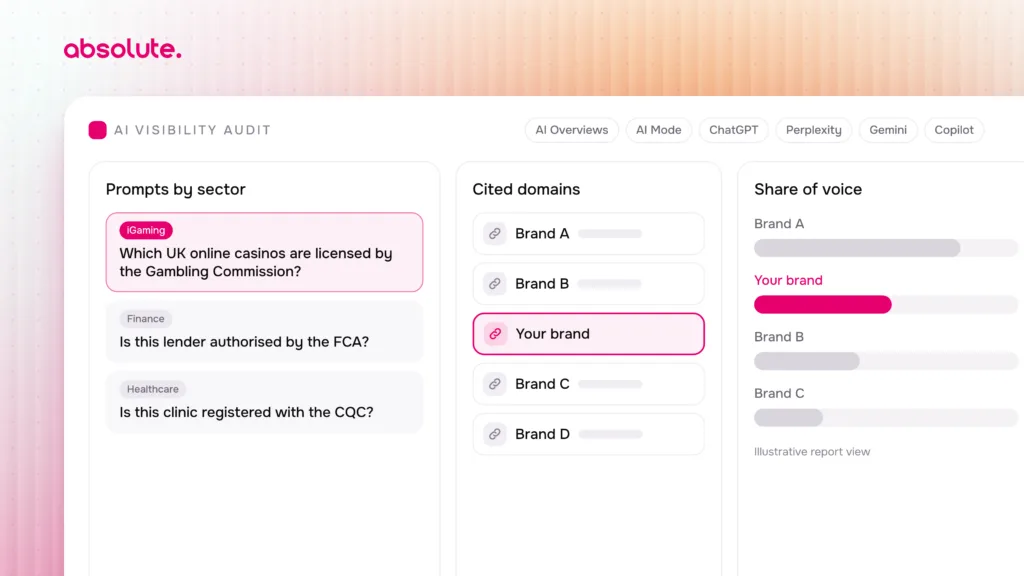
An AI visibility audit is a structured test of how AI assistants represent your brand: it runs a fixed set of buyer questions through ChatGPT, Gemini, Perplexity and Google's AI features, records which brands are named and which pages are cited, and turns the gaps into a prioritised list of fixes. It is a baseline, not a campaign.
The audit exists because AI answers don't behave like a results page. A search results page shows ten links you can track with a rank tracker. An AI answer shows a handful of named brands and a few source links, and those change with the wording of the question, the platform and even the mode the user picks. Semrush found that ChatGPT's reasoning modes overlap on only about 25% of the sources they cite for the same prompts (Semrush, June 2026). A single manual check in one chat window tells you very little.
An audit is also different from ranking well. Ahrefs found that only about 38% of the pages cited in Google's AI Overviews rank in the top 10 for the same query (Ahrefs, March 2026). A brand can hold position one in Google and still be absent from the answer, which is exactly the situation Stelrad was in before its GEO programme (more below).
Three definitions are worth fixing before you read any report:
- AI visibility is how often, how prominently and how accurately AI assistants include a brand in their answers to relevant questions.
- A prompt set is the fixed list of questions an audit tests, written the way real buyers phrase them, so results can be compared over time.
- GEO (generative engine optimisation) is the work of making a brand's pages and reputation the sources AI answers choose to name and cite.
What does an AI visibility audit measure?
An AI visibility audit measures five things for each prompt and platform: whether your brand is mentioned, whether your site is cited as a source, your share of voice against named competitors, the sentiment of how you're described, and whether the facts stated about you are correct. Together they show not just whether you appear, but why you don't.
| Metric | Definition (one sentence) | What it tells you |
|---|---|---|
| Mentions | The number of answers in the prompt set that name your brand. | Whether the assistant knows you exist for this topic. |
| Citations | The number of answers that link to a page on your domain as a source. | Whether your own pages are trusted enough to quote. |
| Share of voice | Your mentions as a percentage of all brand mentions across the prompt set. | How you compare with the competitors buyers are offered. |
| Sentiment | Whether the language used about your brand is positive, neutral or negative. | How you're framed when you are named. |
| Accuracy | Whether the facts stated about you (licence, products, locations, prices) are correct. | Where wrong information could cost you a customer or a compliance problem. |
| Cited domains | The third-party sites the answers quote for your topic. | Which pages you need to replace, or appear on. |
Mentions and citations are not the same thing, and the difference matters. A mention means the assistant named you, often because other sites discuss you. A citation means the assistant linked to your page as evidence. Tools such as Ahrefs Brand Radar report mentions, citations, AI share of voice and estimated impressions as separate measures for this reason (Ahrefs Brand Radar, November 2026).
Accuracy is the measure regulated brands should weight most heavily. An assistant that names a lender but gets its FCA status wrong, or describes a casino's licence incorrectly, creates a risk that a share-of-voice chart will never show. Every factual claim an audit records should be checked against the primary register: the UK Gambling Commission public register, the FCA Financial Services Register or the Care Quality Commission for health providers.
How is an AI visibility audit carried out?
An AI visibility audit is carried out in four steps: agree the scope (platforms, markets, competitors), write a prompt set that mirrors real buyer questions, run every prompt on every platform and record the answers and citations, then analyse the gaps and rank the fixes. The prompt set is the step that decides whether the audit is useful.
- Scope. Choose the platforms (ChatGPT, Gemini, Perplexity, Google AI Overviews and AI Mode, Microsoft Copilot), the market (UK, or each country you're licensed in) and three to five competitors your buyers actually compare you with.
- Prompt set. Write the questions buyers ask at each stage: category questions ("which lenders…"), comparison questions ("X vs Y"), trust questions ("is X licensed…") and branded questions ("what is X like…"). Use the buyer's wording, not your keyword list.
- Collection. Run each prompt on each platform, more than once and in more than one mode where the platform has them, and record the answer, the brands named, the order they appear in and every cited URL.
- Analysis. Score the five metrics, list the domains cited instead of you, flag wrong facts, and map each gap to a page on your site that could fix it.
Ahrefs publishes an eight-step version of this process for brands running it themselves, from defining the scope to turning the findings into a strategy (Ahrefs, October 2025). The method is not secret. What separates a useful audit from a screenshot exercise is the prompt set and the analysis.
Tools make collection faster and repeatable. Ahrefs Brand Radar tracks AI Overviews, AI Mode, ChatGPT, Perplexity, Gemini and Copilot (Ahrefs). Semrush's AI Visibility Toolkit reports an AI Visibility Score, share of voice, sentiment and prompt tracking for ChatGPT and Google AI Mode (Semrush Knowledge Base). Profound reports citation analytics and a visibility score by platform across ChatGPT, Perplexity, Claude, Gemini, Copilot, DeepSeek and AI Overviews (Profound). Peec AI tracks visibility, position and sentiment for brands across ChatGPT, Perplexity and Gemini (Peec AI).
What prompts should an audit test for regulated brands?
An audit for a regulated brand should test the questions buyers ask before they choose a provider, including the trust questions about licences and registration that only regulated sectors get. Generic prompts such as "best agency" or "top casino" miss the long, specific questions where buyers decide, and miss the caveats assistants add in regulated categories.
Assistants answer regulated questions differently. They add warnings, decline to recommend, or cite comparison sites, affiliates and forums rather than the licensed brand. That's why the prompt set has to include the sector's own trust questions. The sample sets below are starting points that an audit would expand to 30 to 100 prompts per market. Replace "this casino", "this lender" or "this clinic" with your brand name for the branded checks.
Sample prompt set: iGaming
| Stage | Prompt | What to record |
|---|---|---|
| Category | Which UK online casinos are licensed by the Gambling Commission? | Brands named, whether answers cite operators or affiliates |
| Category | Which betting sites pay out fastest in the UK? | Cited domains, whether your withdrawal facts are stated correctly |
| Trust | Is this casino safe to use? | Whether the answer states your UKGC licence correctly, sentiment |
| Comparison | Is this casino better than [named competitor]? | Share of voice, which source the comparison leans on |
| Responsible gambling | Does this casino offer deposit limits? | Accuracy against your safer gambling tools |
Gambling answers often lean on affiliate sites. ADM's iGaming operator's guide to AI search visibility explains why licensed operators lose these answers and how to win them back. Operator content is still bound by the UK Gambling Commission's rules and the ASA's CAP Code, so an audit records what assistants say; it never suggests promotional copy to fix it.
Sample prompt set: financial services
| Stage | Prompt | What to record |
|---|---|---|
| Category | Which lenders offer short-term loans for bad credit in the UK? | Brands named, whether comparison sites dominate the citations |
| Trust | Is this lender authorised by the FCA? | Whether the authorisation is stated correctly |
| Category | Best business account for a limited company | Share of voice against banks and challengers |
| Comparison | What are the alternatives to [named lender]? | Which brands are offered as alternatives to yours |
| Cost | What does this lender charge if I repay early? | Accuracy of product facts against your own terms |
Finance answers are where wrong facts do most harm. A misquoted fee or authorisation status is worth more attention than a missing mention. Our GEO for financial services page sets out how we work within financial promotion rules.
Sample prompt set: healthcare
| Stage | Prompt | What to record |
|---|---|---|
| Category | Where can I get a hair transplant in the UK? | Clinics named, whether directories or the clinics are cited |
| Trust | Is this clinic registered with the CQC? | Whether registration is stated correctly |
| Choice | How do I choose a private dermatologist? | Whether your expertise pages are cited as guidance |
| Comparison | What are the alternatives to [named clinic]? | Share of voice in your city or region |
| Practical | What happens at a first consultation at this clinic? | Accuracy against your published patient information |
Health answers carry medical caveats, and should. The audit's job is to check that where an assistant does describe your clinic, the facts are right and the source is your own page. Our GEO for healthcare page covers the rules we work to.
Marketing guidance, not legal, financial or medical advice. Regulator registers linked in this guide were checked on 2 November 2026.
What does a finished AI visibility audit report contain?
A finished AI visibility audit report contains a one-page summary, the five metrics by platform and by competitor, the list of domains cited instead of you, a log of factual errors, and a ranked action plan that names the pages to create or fix. If a report ends with a score and no page list, it's a dashboard export, not an audit.
A typical structure, anonymised, looks like this:
| Section | What's in it | The question it answers |
|---|---|---|
| 1. Summary | Headline share of voice, the three biggest gaps, the first three fixes | Where do we stand? |
| 2. Visibility by platform | Mentions and citations for ChatGPT, Gemini, Perplexity, AI Overviews, AI Mode | Where are we strong and weak? |
| 3. Competitor comparison | Share of voice for each competitor across the prompt set | Who's being recommended instead? |
| 4. Cited domains | The sites answers quote for your topic, with how often | Which pages do we need to replace or appear on? |
| 5. Accuracy log | Every wrong or out-of-date fact, with the prompt and platform | What could mislead a customer? |
| 6. Prompt-level detail | Every prompt, answer, brand list and citation | What exactly did each assistant say? |
| 7. Action plan | Pages to fix or create, off-site sources to earn, technical checks | What do we do first? |
The prompt-level detail is the evidence. A sample row looks like this:
| Prompt | Platform | Brands named | Cited domains | Your status |
|---|---|---|---|---|
| Is this lender authorised by the FCA? | ChatGPT | Your brand | register.fca.org.uk, a comparison site | Mentioned, not cited; status correct |
| Which lenders offer short-term loans for bad credit in the UK? | Google AI Overviews | Four competitors | Two comparison sites, one forum | Not mentioned |
The technical section matters more than many buyers expect. If your site blocks OAI-SearchBot, OpenAI says it won't be shown in ChatGPT search answers (OpenAI). An audit should check your robots.txt and crawler access before anyone spends money on content.
How much does an AI visibility audit cost?
An AI visibility audit costs from around £595 for a fixed-scope report from a UK provider (Wildcurrant, November 2026), while self-serve tracking tools start at $99 to $199 a month. Most agencies don't publish a price because the cost depends on the number of prompts, platforms, markets and competitors in scope.
| Option | Published price (checked 2 Nov 2026) | What you get |
|---|---|---|
| Semrush AI Visibility Toolkit | $99 a month (Semrush) | One project, 25 tracked prompts, score, share of voice, sentiment |
| Ahrefs Brand Radar custom prompts | From $50 a month (Ahrefs) | Your own prompts tracked across AI platforms |
| Ahrefs AI Visibility Index | From $199 a month (Ahrefs) | Brand visibility index across AI platforms |
| Fixed-scope agency audit (UK example) | £595 (Wildcurrant) | Written report, prioritised plan, record of AI answers, a call |
| Bespoke agency audit | Quoted after scoping | Sector prompt sets, several markets, competitor analysis, action plan |
The cost drivers are predictable:
- Prompts. A 30-prompt set for one market is a different job from 100 prompts across three markets.
- Platforms. Each platform and mode adds collection and analysis time.
- Markets and languages. Licensed operators in several jurisdictions need a prompt set per market.
- Competitors. Each additional competitor adds share-of-voice and cited-domain analysis.
- Regulatory checking. Verifying every stated fact against the regulator's register takes time, and it's the part regulated brands can't skip.
Absolute Digital Media scopes each audit on a short call and quotes for that scope, so you only pay for the platforms, markets and prompts that matter to your buyers.
How should you read the results?
You should read an AI visibility audit from the cited domains backwards: start with who is being quoted instead of you, then check what the answers get wrong, then find the page on your own site that could replace the cited source. Share of voice tells you the size of the problem; the cited domains tell you where to start.
Three readings come up in almost every regulated-sector audit:
- You're mentioned but not cited. The assistant knows your brand from other sites but doesn't trust your own pages enough to quote them. The fix is usually on your site: clearer answers, facts stated plainly, pages that answer the exact question.
- A third party is cited for your facts. An affiliate, forum or comparison site is the source for your licence, fees or services. Your page needs to be the clearer, more current answer, and the third-party sources need correcting where you can.
- You're absent from category answers. You appear for branded questions but not for "which lenders…" or "where can I get…". That's a content and authority gap: the sector pages, guides and off-site coverage that category answers draw on.
Be careful with month-to-month movement. AI citation patterns shift quickly: Semrush tracked Reddit's share of ChatGPT citations falling from 3.8% to 0.5% (Semrush, August 2026). A single audit is a baseline. The trend comes from repeating the same prompt set.
What happens after the audit?
After the audit, you fix the pages AI answers already cite for your topic first, correct wrong facts at their source, then build the missing pages and off-site coverage the category answers rely on. The audit's action plan should give you that order, page by page, so the first month of work is obvious.
For Stelrad, the UK radiator manufacturer, the audit showed a brand that ranked first in Google for "radiators" while AI answers to radiator questions quoted retailer buying guides. Absolute Digital Media rebuilt the advice hub as the citation source and pointed link building and digital PR at the same guides (Stelrad GEO case study).
| Measure (Ahrefs Brand Radar) | Stelrad |
|---|---|
| AI citations, all platforms | 2,389 across 405 pages |
| Google AI Mode citations | 557 across 231 pages |
| Share of voice in AI Overviews, radiator questions | 62% (next retailer 30%) |
Source: Stelrad GEO case study, Absolute Digital Media, figures from Ahrefs Brand Radar. The programme is shortlisted for Best AI Search Optimisation Campaign at the UK Search Awards 2026, with winners announced on 25 November.
The same approach runs through our work for Fast Loan UK in consumer finance and The Swallow Co. For regulated brands, the order matters: fix accuracy before you chase share of voice, because a wrong fact cited more often is a bigger problem, not a smaller one. We also avoid shortcuts that buy mentions; our view on why is in Google has declared war on bought AI citations.
How often should an AI visibility audit be repeated?
An AI visibility audit should be repeated quarterly for most regulated brands, using the same prompt set so results are comparable, with monthly tracking in a tool between audits. Repeat it sooner after a site migration, a rebrand, a licence change or a major platform update.
The reason is volatility. Platforms change how they search and cite, sometimes in a single month, and models change between versions. Keeping the prompt set fixed is what turns separate audits into a trend line. Adding new prompts is fine; changing the old ones breaks the comparison.
An AI visibility audit is worth paying for when it ends in a list of pages to fix. A score on its own tells you that you're missing, not why.
See where your brand stands in AI answers
Absolute Digital Media runs AI visibility audits for regulated brands in iGaming, finance, healthcare and other sectors. We test the prompts your buyers ask, check every fact against the regulator's register, show you which pages AI answers cite instead of yours, and give you the order to fix them in.
Sources
- Ahrefs – Update: 38% of AI Overview citations pull from the top 10, March 2026
- Ahrefs – AI visibility audit: how to measure your brand's presence, October 2025
- Ahrefs – Brand Radar, features and pricing, checked 2 November 2026
- Semrush Knowledge Base – AI Visibility Toolkit, checked 2 November 2026
- Semrush – Only 25% of cited sources overlap between ChatGPT's reasoning modes, June 2026
- Semrush – Reddit's citations in ChatGPT fall from 3.8% to 0.5%, August 2026
- Profound – AI visibility platform, checked 2 November 2026
- Peec AI – AI search analytics, checked 2 November 2026
- Wildcurrant – AI visibility audit, price and scope, checked 2 November 2026
- OpenAI – Overview of OpenAI crawlers
- UK Gambling Commission – Public register
- Financial Conduct Authority – Financial Services Register
- Care Quality Commission
Frequently asked questions
What is an AI visibility audit?
An AI visibility audit is a structured test of how ChatGPT, Gemini, Perplexity and Google's AI features represent your brand. It runs a fixed set of buyer prompts, records which brands are named and which pages are cited, checks the facts stated about you, and turns the gaps into a prioritised list of pages to fix.
Which tools measure AI visibility?
The main AI visibility tools are Ahrefs Brand Radar, Semrush's AI Visibility Toolkit, Profound and Peec AI. They track mentions, citations, share of voice and sentiment across platforms such as ChatGPT, Gemini, Perplexity and Google's AI Overviews. They measure visibility; an audit adds the analysis that decides what to fix.
How much does an AI visibility audit cost?
Published prices start at around £595 for a fixed-scope UK agency audit, and self-serve tools start at $99 to $199 a month (November 2026). Bespoke audits for regulated brands are usually quoted after scoping, because the cost depends on prompts, platforms, markets, competitors and regulatory fact-checking.
How often should it be repeated?
Repeat an AI visibility audit every quarter using the same prompt set, with monthly tracking in a tool between audits. Run one sooner after a site migration, rebrand, licence change or major platform update, because AI citation patterns can shift within a single month.
What happens after the audit?
After the audit, fix the pages AI answers already cite for your topic, correct any wrong facts at their source, then build the missing sector pages and off-site coverage that category answers rely on. A good audit's action plan lists those steps page by page, in order.