No, GEO is not replacing SEO. Generative engine optimisation (GEO) is the work of being found and represented well in AI answers from Google AI Overviews, AI Mode and ChatGPT, and it rests on the same foundations as SEO. Google’s own guidance (May 2025) says SEO best practices still apply to its AI features. What has changed is how answers are assembled, not what earns trust.
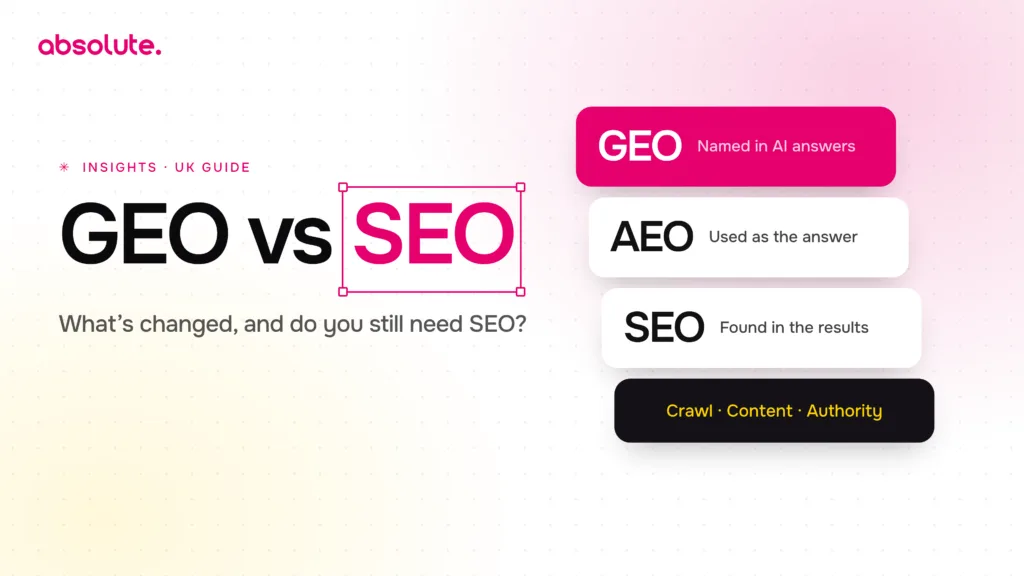
- GEO, AEO and SEO describe one job seen from three angles: being found in classic results, in direct answers and in AI-written answers.
- Google says there are no extra requirements to appear in AI Overviews or AI Mode: a page must be indexed and eligible for a snippet (Google Search Central, checked 5 November 2026).
- AI Mode has been live in the UK since 28 July 2025 and AI Overviews since August 2024, so UK buyers already meet AI answers on everyday searches.
- In Pew Research Center’s March 2025 study of 900 US adults, people clicked a result on 8% of Google visits with an AI summary against 15% without one.
- “geo vs seo” gets 800 UK searches a month (Ahrefs, November 2026), and the top results are mostly US articles and Reddit threads.
If you run a UK business or its marketing, you have probably been told in the last few months that SEO is finished and you now need “GEO” instead. That claim is wrong, but it is not coming from nowhere. Search really has changed: Google answers many questions itself, and a growing share of research starts in ChatGPT. The question is what that means for the money you already spend on SEO.
This guide from Absolute Digital Media (ADM) explains what SEO, GEO and AEO each mean, what has stayed the same, what is genuinely new, and how we would split a UK SME’s search budget today. It follows on from last week’s guide to AI visibility audits, which covers how to check where you stand. This one is about what to do with the answer.
What is the difference between SEO, GEO and AEO?
SEO, GEO and AEO are three names for being found when someone searches, each focused on a different kind of result. SEO targets the ranked list of links. AEO targets the single direct answer (a featured snippet, a voice answer, a “People also ask” box). GEO targets the answers written by AI tools, which summarise several sources at once and may or may not link to them.
Search engine optimisation (SEO) is the practice of making a website easy for search engines to crawl, understand and trust, so its pages rank for the searches its customers make. It covers technical health, content and authority (links and mentions from other sites).
Answer engine optimisation (AEO) is the practice of structuring content so a search engine or assistant can lift a short, direct answer from it. The term dates from the era of featured snippets and voice assistants, well before ChatGPT.
Generative engine optimisation (GEO) is the practice of improving how often and how accurately a brand appears in answers written by AI systems such as Google AI Overviews, Google AI Mode and ChatGPT. The term was coined in a 2023 research paper from Princeton University and partners, GEO: Generative Engine Optimization, later accepted to the KDD 2024 conference.
You will also see “AI search optimisation”, “LLM SEO” and “AI SEO” used for the same idea. In UK search data they are all live terms: “ai search optimisation” gets 1,100 searches a month and “llm seo” 500 (Ahrefs Keywords Explorer, UK, November 2026). The names are new. Most of the work behind them is not.
SEO vs GEO vs AEO: how do they compare?
The clearest way to compare SEO, GEO and AEO is by what each one is trying to win and what it depends on. The table below sets them side by side on the same criteria. The last row is the one most businesses miss: all three depend on the same foundations.
| SEO | AEO | GEO | |
|---|---|---|---|
| What it targets | Ranked links on a results page | One direct answer (snippet, voice, “People also ask”) | Answers written by AI tools (AI Overviews, AI Mode, ChatGPT) |
| What “winning” looks like | A high position and a click | Your wording used as the answer | Your brand named, described accurately, often linked |
| How it is measured | Rankings, organic traffic, leads | Snippet ownership, answer impressions | Brand mentions and links in AI answers for a set of prompts |
| Main levers | Technical health, content, links | Clear question-and-answer structure | The same as SEO, plus how your brand is described across the web |
| Where it came from | The 1990s | The featured-snippet and voice era (late 2010s) | A 2023 research paper; mainstream since 2025 |
| Depends on | Crawlable, indexable, trusted pages | A page that already ranks or is indexed | A page that is indexed, trusted and easy to quote |
The pattern in the last row is the point of this article. An AI answer cannot use a page it cannot find, and Google’s AI features draw on the same index as its classic results. GEO without SEO is building on sand.
Is GEO replacing SEO?
GEO is not replacing SEO, because the AI answers GEO aims at are built on the same crawling, indexing and ranking systems SEO has always worked with. Google states plainly that “there are no additional requirements to appear in AI Overviews or AI Mode, nor other special optimizations necessary”, and that “the best practices for SEO remain relevant” (Google Search Central, checked 5 November 2026).
The same page sets the bar for being shown as a supporting link in an AI answer: “a page must be indexed and eligible to be shown in Google Search with a snippet.” That is an SEO requirement, word for word. If your site has indexing problems, thin pages or no authority, it is not eligible for the AI answer either.
Google’s John Mueller put it this way in May 2025: “The underpinnings of what Google has long advised carries across to these new experiences” (Top ways to ensure your content performs well in Google’s AI experiences on Search).
So why does “is GEO replacing SEO?” keep coming up? Partly because the term is useful for selling a new product. Partly because some things really have changed, and the old way of reporting SEO (rankings and clicks alone) no longer shows the whole picture. Both of those are true at once. SEO is not dead, and SEO that ignores AI answers is incomplete.
What has stayed the same?
The things that made a site rank in 2023 are still the things that make it eligible for AI answers in 2026: a technically healthy site, content that answers real questions well, and authority earned from other sites. None of these has been replaced. If anything, each matters more, because AI answers are selective about which few sources they draw on.
Technical health. Search engines and AI crawlers still need to reach, render and index your pages. Slow, broken or blocked pages are invisible to both. OpenAI says its own crawler, OAI-SearchBot, “is used to surface websites in search results in ChatGPT’s search features”, and that sites which block it “will not be shown in ChatGPT search answers” (OpenAI crawler documentation, checked 5 November 2026). Crawl access is the first gate everywhere.
Content that helps people. Google’s advice for AI features is the same advice it has given for years: “Focus on your visitors and provide them with unique, satisfying content” (Google Search Central blog, May 2025). Its guide to creating helpful, reliable, people-first content has not been rewritten for AI.
Authority and trust. Links and mentions from relevant, trusted sites are still how search engines judge whether you are worth showing. An AI answer that recommends a supplier is still drawing on what the web says about that supplier.
Your own expertise. A page that only repeats what ten other pages already say gives an AI answer no reason to use it over the others. Original experience, clear explanations and specific detail still win.
What has actually changed in how AI search chooses sources?
What has changed is how the answer is assembled. A classic search returns ten links and the searcher chooses. An AI answer runs several searches on the searcher’s behalf, reads the results and writes one response, naming or linking a handful of sources. Being one of those sources depends on your pages being the clearest, most trusted answer to the smaller questions inside the big one.
Google calls this “query fan-out”: AI Overviews and AI Mode may issue “multiple related searches across subtopics and data sources” to develop a response (Google Search Central). In practice, a question such as “which accountant should a small Leeds business use?” is broken into sub-questions about fees, specialisms, reviews and location, and each is answered from whichever pages cover it best.
Three changes follow from that for a UK business:
- The click is less certain. In Pew Research Center’s study of 900 US adults’ Google searches in March 2025, people clicked a traditional result on 8% of visits where an AI summary appeared, against 15% where none did, and clicked a link inside the summary on about 1% (Pew Research Center, 22 July 2025). The study is US data, but the same features run in the UK.
- Being named matters, not just being ranked. If the answer names three suppliers and you are not one, a high position further down the page does less work than it did. Google does say the clicks it does send from AI Overviews “are higher quality, where users are more likely to spend more time on the site” (Google, May 2025).
- The questions are longer. AI Mode is built for long, multi-part questions and follow-ups, which rewards sites that cover a topic in depth rather than one keyword per page.
These features are not on their way to the UK. They are here. Google rolled AI Overviews out in the UK in August 2024 (Engadget, 15 August 2024) and AI Mode on 28 July 2025, with no sign-up needed (9to5Google, 28 July 2025).
Does ChatGPT choose sources the same way as Google?
ChatGPT does not use Google’s index, but it works on the same principle: when it searches the web it needs to be able to crawl your site, and it favours sources that answer the question clearly and are trusted elsewhere. OpenAI’s search crawler, OAI-SearchBot, decides which sites can appear in ChatGPT’s search answers, and a site that blocks it is left out (OpenAI).
The practical difference is reach, not method. Google AI Overviews and AI Mode sit on top of Google Search, so your existing SEO feeds them directly. ChatGPT is a separate system, so two extra checks are worth making: that your robots.txt and firewall do not block AI search crawlers you want to be found by, and that the way other sites describe your business (directories, reviews, press, partner pages) is accurate and consistent. Neither is a new discipline. Both are things a thorough SEO programme should already cover.
Is your SEO out of date?
Your SEO is probably not out of date in what it does, but it may be out of date in how it is planned and reported. A programme built around a fixed list of keywords and a monthly rankings report misses the longer, conversational questions people now ask, and it cannot show whether your brand appears in AI answers at all.
Four signs your current SEO needs updating for AI search:
- Reporting stops at rankings and sessions. Nobody checks what AI Overviews, AI Mode or ChatGPT say about you or your competitors for the questions that matter to your sales.
- Content is one page per keyword. Pages target short phrases rather than answering the full question a buyer brings, including the follow-ups.
- Technical work is a one-off. Nobody has checked recently whether AI crawlers can reach your key pages, or whether your structured data is current.
- Authority work stops at links. Mentions in trusted UK publications, directories and reviews are not tracked, even though they shape how AI answers describe you.
If none of these apply, your SEO is in good shape for AI search already. If two or more do, the fix is usually a change of plan and reporting, not a new agency or a separate budget line.
Where should a UK SME spend its search budget now?
A UK SME should keep funding the foundations first and add AI visibility as part of the same programme, not as a separate product bought on top. The order matters more than the split: an AI answer cannot recommend a site it cannot crawl or does not trust, so money spent on “GEO” before the basics are sound is mostly wasted.
This is how we at Absolute Digital Media would prioritise, depending on where a business starts:
| Where you are now | Spend first on | Then | Why |
|---|---|---|---|
| Site has technical or indexing problems | Fixing crawl, indexing, speed and structure | Content and authority | Pages that aren’t indexed can’t rank or appear in AI answers |
| Site is healthy, content is thin | Content that fully answers your buyers’ questions | Authority and AI answer tracking | AI answers draw on the clearest, most complete sources |
| Site and content are good, little authority | Earning links and mentions from trusted UK sites | AI answer tracking | Trust is what separates you from equally good content |
| Strong SEO already | Tracking AI answers for your key questions and closing the gaps | Ongoing content and authority | You are eligible already; the job is to be chosen |
What we would not do is split the budget into an “SEO” pot and a “GEO” pot run by different people. The work overlaps too much: the same pages, the same technical fixes, the same authority. Running them apart means paying twice for one job and getting two sets of advice that pull in different directions.
What should you ask anyone selling you GEO?
Before you pay for GEO as a separate service, ask how it differs from good SEO in practice and how results will be measured. A credible answer will name the specific work (technical, content, authority), the prompts and questions that will be tracked, and how often. A weak answer leans on new jargon, guarantees, or the claim that your current SEO is now worthless.
Five questions worth asking:
- Which parts of this work are different from the SEO we already pay for, and which overlap?
- Which questions and prompts will you track, on which AI tools, and how often?
- How will you show what changed because of your work, rather than because the AI tools changed?
- What will you fix on our site, and what will you do off it?
- Can you guarantee placements in AI answers? (The honest answer is no. Nobody controls what Google or OpenAI’s systems write, so treat any guarantee as a warning sign.)
Figures are UK search data from Ahrefs and Semrush pulled on 5 November 2026, and published research as dated in each sentence. Search features change often: we re-check this guide’s sources every quarter.
Not sure if your SEO is ready for AI search?
Absolute Digital Media runs SEO and GEO as one programme: the same technical, content and authority work, reported in Google rankings and in AI answers. Book a free 30-minute SEO and GEO strategy call with Ben Austin, our founder. You’ll get a straight view of what your current SEO already covers, what’s missing for AI search, and where your budget should go first.
Frequently asked questions
Is GEO replacing SEO?
No. GEO builds on SEO rather than replacing it. Google says the best practices for SEO remain relevant to AI Overviews and AI Mode, and that a page must be indexed and eligible for a snippet to appear as a supporting link. A site that is weak at SEO is weak in AI search too.
What is the difference between GEO and AEO?
AEO (answer engine optimisation) aims to have your content used as a single direct answer, such as a featured snippet or a voice answer. GEO (generative engine optimisation) aims to have your brand named and described accurately in answers written by AI tools, which combine several sources. Both rely on clear, trusted, well-structured pages.
Do I need a separate GEO agency as well as an SEO agency?
Usually not. GEO and SEO share the same foundations: technical health, helpful content and authority. Splitting them between two suppliers means paying twice for overlapping work. A better approach is one programme that covers classic rankings and AI answers, with reporting on both.
Can anyone guarantee my business will appear in AI answers?
No. Nobody controls what Google AI Overviews, AI Mode or ChatGPT write, and the systems change often. An honest agency can improve the signals AI tools rely on and track how often you appear for the questions that matter, but it cannot promise placements. Treat any guarantee as a warning sign.
Is SEO still worth paying for in 2026?
Yes, if it is done properly. Google’s AI features draw on its search index, and ChatGPT’s search depends on being able to crawl your site, so SEO is now the entry ticket to both classic results and AI answers. What has changed is how SEO should be planned and measured, not whether it is needed.
Sources
- Google Search Central: AI features and your website, checked 5 November 2026
- Google Search Central blog: Top ways to ensure your content performs well in Google’s AI experiences on Search, John Mueller, 21 May 2025
- Google Search Central: Creating helpful, reliable, people-first content
- Aggarwal et al., GEO: Generative Engine Optimization, arXiv 2311.09735, November 2023 (KDD 2024)
- Pew Research Center: Google users are less likely to click on links when an AI summary appears in the results, 22 July 2025
- OpenAI: Overview of OpenAI crawlers (OAI-SearchBot), checked 5 November 2026
- 9to5Google: Google AI Mode rolling out in the UK, 28 July 2025
- Engadget: Google brings AI Overviews to six more countries, including the UK, 15 August 2024
- Ahrefs Keywords Explorer, UK database, pulled 5 November 2026: geo vs seo 800/mo (KD 24), geo seo 1,300 (KD 35), answer engine optimisation 800 (KD 34), ai search optimisation 1,100 (KD 25), llm seo 500
- Semrush Keyword Overview, UK database, pulled 5 November 2026: geo vs seo 880/mo, geo seo 1,600, answer engine optimisation 590, ai search optimisation 720