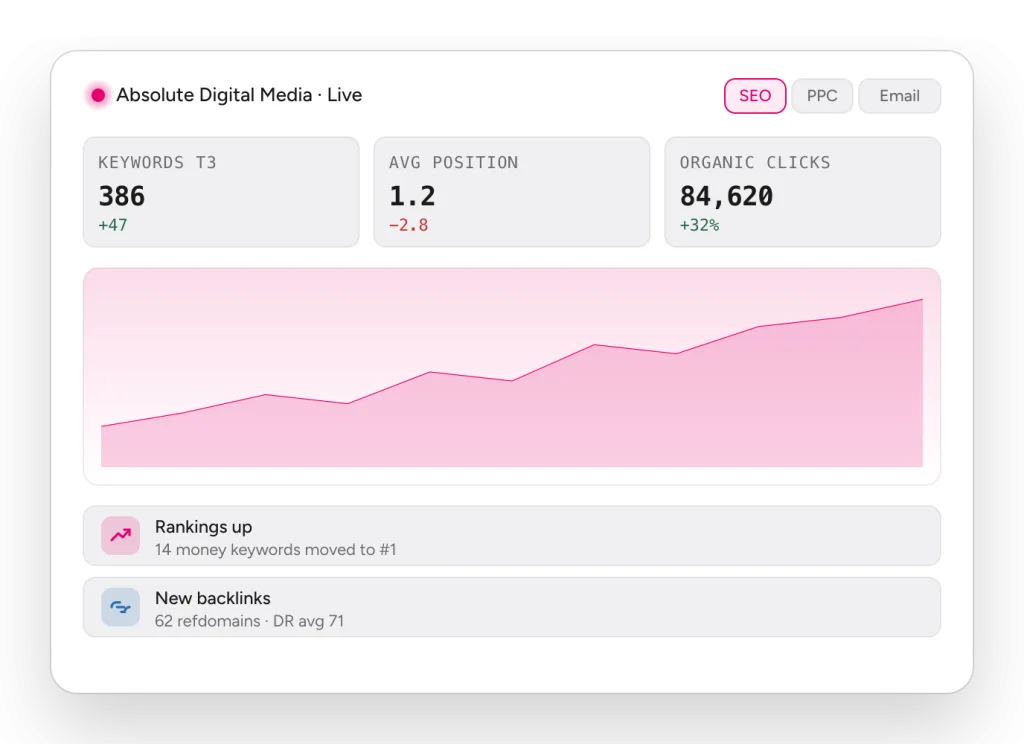

Manufacturers win page one for product searches by competing for the generic category term, not just their brand name. That means fixing cannibalisation, building a page for each query set, ranking pre-purchase tools and pointing links at the category pages that sell. Stelrad did this and took position one for “radiators”, with organic traffic up 575% (Absolute Digital Media, Stelrad SEO case study).
- Stelrad’s organic traffic rose from 21,760 to a peak of 146,911 sessions (+575%), according to Absolute Digital Media’s published Stelrad SEO case study.
- Stelrad’s top-three keywords grew from 332 to a peak of 2,354, and its radiators category page from 4,079 to 51,687 monthly sessions (same case study).
- Absolute Digital Media resolved cannibalisation before adding 154 new category and range pages, each assigned its own query set.
- Stelrad’s radiators category page holds 229 referring domains, and four category pages reached position one: radiators, electric, column and designer (Stelrad link building case study).
- Stelrad holds a 62% share of voice in Google AI Overviews for its radiator questions, against 30% for Screwfix (Stelrad GEO case study).
Most manufacturers have the same problem in Google: the people who resell their products outrank them. National retailers, merchants and marketplaces have bigger sites, more links and catalogues built for search, so the manufacturer ends up ranking for its own brand name and little else.
Stelrad, the UK radiator manufacturer, was in exactly that position. Absolute Digital Media (ADM) ran its SEO programme and took it to position one for “radiators”, a term where national retailers such as Screwfix and B&Q also rank (Ahrefs SERP overview, UK, 13 Nov 2026) and where, as the case study puts it, many competitors sell Stelrad’s own products. This guide sets out the six decisions that got it there, with the published numbers, and how another manufacturer can use them. If you’d rather talk it through for your own category pages, you can book a call with Ben Austin.
Why do retailers outrank manufacturers for their own products?
Retailers outrank manufacturers because Google ranks pages, not brands, and retailer category pages usually have more links, more products and more search-shaped structure than a manufacturer’s catalogue. A manufacturer site is typically organised the way the factory thinks (ranges, model codes, PDF datasheets), while searchers type generic needs such as “black radiator” or “radiator size calculator”.
Absolute Digital Media’s Stelrad SEO case study names four constraints that any manufacturer selling through resellers will recognise:
- Head terms are contested by national retailers and merchants, many of which sell the manufacturer’s own products.
- Category and product pages compete with each other (cannibalisation) across a large estate.
- The site was built around the catalogue rather than search demand.
- Crawl, indexation and hierarchy problems had to be engineered out first.
The Stelrad link building case study adds the authority problem: Stelrad’s Domain Rating of 57 was strong, but that authority sat on the homepage rather than on the category pages where retailers were winning. Manufacturing SEO is the work of moving a manufacturer’s demand, structure and authority onto the pages that answer generic product searches.
Lesson 1: Should a manufacturer chase generic category terms?
Yes. A manufacturer that only ranks for its brand and model codes is ranking for people who have already chosen it; the generic category term is where the buying decision is still open. Stelrad chose to compete for terms like “radiators” rather than settle for “Stelrad radiators”, and supported those pages with specification, sizing and engineering content that retailers could not match.
The prize is large. Ahrefs puts UK search volume for “radiators” at 49,000 a month (Ahrefs Keywords Explorer, UK, pulled 13 Nov 2026), and the link building case study says the radiators page holds position one for “radiator” and “radiators”, a combined 80,000 monthly searches. Position matters too: Backlinko’s analysis of 4 million Google results found the first organic result averages a 27.6% click-through rate, about ten times the tenth result (Backlinko, Google CTR stats).
What a manufacturer has that a retailer doesn’t is engineering knowledge. Stelrad’s pages answer the questions a buyer asks before choosing: output, sizes, panel types and fitting. That depth is the reason a manufacturer deserves the generic ranking, and the case study shows Google rewarded it.
Lesson 2: How do you stop category and product pages competing with each other?
You audit cannibalisation before you add a single page. ADM mapped which Stelrad URLs were competing for the same queries, resolved those conflicts, and only then added 154 new category and range pages, each assigned its own query set (Stelrad SEO case study). One page, one job, one set of searches.
Keyword cannibalisation is when two or more pages on one site target the same query, so search engines split signals between them and neither ranks well. Google’s own guidance on duplicate content says to consolidate near-identical URLs and signal the preferred version with canonical tags (Google Search Central, consolidate duplicate URLs).
For a manufacturer, the practical version looks like this:
| Step | What you do | Why it matters |
|---|---|---|
| Map | List every category, range and product URL against the queries it ranks for | Shows where pages compete |
| Decide | Pick one owner per query set; merge, redirect or canonicalise the rest | Concentrates signals on one URL |
| Build | Create new category pages only for query sets nobody owns yet | Stelrad added 154 this way |
| Link | Point internal links at each owner from menus, ranges and guides | Tells Google which page matters |
The order is the lesson. Adding pages on top of cannibalisation just creates more pages competing with each other.
Lesson 3: What URL structure works for a manufacturer’s catalogue?
The structure that works mirrors how people search: by product type, colour and specification. ADM restructured Stelrad’s URL hierarchy along exactly those lines and accepted the short-term disruption that a rebuild brings (Stelrad SEO case study). The live site now has category paths such as /radiators/vertical-radiators/ and /radiators/colour-radiators/black-radiators/.
Google’s ecommerce guidance says it works out a page’s importance mainly from internal links, and recommends linking from menus to categories, from categories to subcategories and from subcategories to every product you want indexed, using standard HTML links (Google Search Central, ecommerce site structure). A catalogue organised by range code does the opposite: it buries the pages that match real searches.
The results show what a search-shaped structure does to long-tail pages. In the published case study, Stelrad’s towel rail page went from 104 to 4,665 monthly sessions and the slim flat panel page from 4 to 1,104. Ahrefs shows stelrad.com ranking first for “black radiator” (19,000 UK monthly searches) and “designer radiators uk” (1,900) on dedicated category URLs (Ahrefs Site Explorer, stelrad.com, UK, 12 Nov 2026).
Lesson 4: Can calculators and spec tools rank on page one?
Yes, and for manufacturers they are often the fastest page-one wins. ADM built and optimised Stelrad’s pre-purchase tools, including BTU, heat loss and radiator size calculators. The SEO case study reports them ranking first for “radiator size calculator”, second for “heat loss calculator” and third for “btu calculator”, and the link building case study says they now rank first for “btu calculator” and “radiator calculator”.
A pre-purchase tool is a page that helps a buyer work out what they need before they choose a product. Tools work for manufacturers for three reasons:
- Searchers need an answer only the engineering data can give, which retailers rarely build themselves.
- Installers, trade bodies and journalists link to a useful tool far more readily than to a product page.
- A tool sits one click from the right category page, so the traffic it earns flows to products.
Ahrefs puts “btu calculator” at 15,000 UK monthly searches and “radiator size calculator” at 2,500 (Ahrefs Site Explorer, stelrad.com, UK, 12 Nov 2026). Every manufacturer has an equivalent: a load calculator, a sizing chart, a compatibility checker, a coverage estimator.
Lesson 5: Where should a manufacturer point its links?
At the category pages that sell, not the homepage. Retailers and aggregators held stronger page-level authority on the category pages competing for home heating terms, so ADM targeted six Stelrad category pages with the radiators page first (Stelrad link building case study). The radiators page now holds 229 referring domains, and four category pages reached position one: radiators, electric, column and designer.
| Category page | Referring domains (Ahrefs, per the case study) |
|---|---|
| /radiators/ | 229 |
| /towel-rail-radiators/ | 204 |
| /electric-radiators/ | 144 |
| /vertical-radiators/ | 131 |
| /designer-radiators/ | 108 |
| /column-radiators/ | 98 |
Two sources fed those links. The first was trade and institutional sites, such as the Chartered Institution of Building Services Engineers (CIBSE), the Chartered Institute of Plumbing and Heating Engineering (CIPHE) and the manufacturers’ organisation Make UK, alongside merchants and housebuilders. The second was digital PR: ADM’s Stelrad digital PR case study reports referring domains up from 355 to 2,330 (+556%) and 30 verified placements averaging DR 84, the highest being Forbes.
The digital PR lesson is counter-intuitive for a manufacturer. The campaigns pitched lifestyle, property and consumer desks with consumer-interest stories, not product launches to trade press. In the case study’s words, the task was “authority type, not authority volume”. Read more on how ADM approaches link building.
Lesson 6: Does page one still matter now AI answers sit above it?
Page one still matters, and the same work now decides who AI answers cite. Before ADM’s GEO programme, retailer buying guides were the sources AI systems cited for radiator questions, with Stelrad mentioned only as a product inside them (Stelrad GEO case study). ADM rebuilt the advice hub so each guide answers in its first paragraph, consolidated thin pages, and pointed links and PR at the same guides.
The published results: 2,389 AI citations across 405 pages, a 62% share of voice in Google AI Overviews (Screwfix 30%, BestHeating 17%), and 557 Google AI Mode citations. In Ahrefs’ live SERP snapshot for “radiators”, stelrad.com is among the first sources cited in the AI Overview (Ahrefs SERP overview, UK, 13 Nov 2026). The pages AI cites most include the column versus panel guide and the radiators category page itself.
Generative engine optimisation (GEO) is the work of getting a brand’s pages cited in AI answers from ChatGPT, Perplexity, Gemini and Google’s AI features. For manufacturers it is the same foundation as SEO: clear answers, a clean structure and authority on the right pages. Our guide to getting visible in Google AI Overviews and AI Mode covers the method, and GEO vs SEO explains where the two differ. ADM’s AI visibility service runs it.
What results can a manufacturer expect, and how fast?
Stelrad’s published figures show what the full programme delivered, but not on a fixed timeline. The SEO case study’s FAQ says ranking movement appeared within two quarters of the first phase, the largest gains came over the following eighteen months, and revenue effects lag rankings by roughly a quarter.
| Measure | Before | After | Source |
|---|---|---|---|
| Organic sessions | 21,760 | 146,911 peak (+575%), now above 127,000 | Stelrad SEO case study |
| Top-three keywords | 332 | 2,354 peak | Stelrad SEO case study |
| Top-ten rankings | 974 | nearly 5,000 | Stelrad SEO case study |
| Radiators page sessions | 4,079 | 51,687 a month | Stelrad SEO case study |
| Domain Rating | 57 | 64 | Stelrad SEO and link building case studies |
| Revenue | baseline | +96%, past the £1 million objective (client data) | Stelrad SEO case study |
| Transactions | baseline | +205% (client data) | Stelrad SEO case study |
Stelrad’s own verdict, from Chris Harvey, Head of Marketing:
“They’ve secured some excellent results so far, helping us progress as a business, which is exactly what we wanted.” – Chris Harvey, Head of Marketing, Stelrad (Stelrad SEO case study)
A manufacturer’s category terms are winnable because the manufacturer knows the product better than anyone who resells it. Search rewards the page that answers the buyer best, and that page should be yours. A link to a category page is worth more to a manufacturer than a link to its homepage, because the category page is the one competing with retailers.
How do you start on your own category pages?
Start by finding the gap between where your category pages rank and where your resellers rank. The checks below take an afternoon with an SEO tool and tell you which of the six lessons matter most for you.
- List your ten most valuable generic category terms and note who ranks in the top five for each.
- Count how many of those top-five results sell your products.
- Check whether two of your own URLs rank for the same term (cannibalisation).
- Compare referring domains to your category pages with the retailer pages above you.
- List the pre-purchase questions your engineers answer every week, and check whether any page on your site answers them.
- Ask ChatGPT and Perplexity which brands they recommend in your category, and note whose pages they cite.
If the answers point to structure, authority or tools, they are fixable. That is the work behind every number in this guide, and it is the same work ADM runs for manufacturers and ecommerce brands.
Want to know what it would take to win your category terms?
Absolute Digital Media (ADM) took Stelrad to position one for “radiators” against the retailers who resell it. Book 30 minutes with Ben Austin, our founder, and we’ll look at your category pages, who outranks you and what would change it.
Sources
- Absolute Digital Media – Stelrad SEO case study
- Absolute Digital Media – Stelrad link building case study
- Absolute Digital Media – Stelrad digital PR case study
- Absolute Digital Media – Stelrad GEO case study
- Ahrefs Keywords Explorer and SERP overview, UK, pulled 13 Nov 2026
- Ahrefs Site Explorer, stelrad.com organic keywords, UK, 12 Nov 2026
- Backlinko – Google CTR stats (4 million search results analysed)
- Google Search Central – Help Google understand your ecommerce site structure
- Google Search Central – Consolidate duplicate URLs
- CIBSE, CIPHE and Make UK – trade and institutional bodies named in the link building case study
Frequently asked questions
Manufacturing SEO is search engine optimisation for companies that make products, so their own site ranks for the generic searches buyers use, not only their brand name. It usually means category pages built to search demand, technical fixes to large catalogues, pre-purchase tools and links pointed at the pages that sell, as in ADM’s work for Stelrad.
In ADM’s Stelrad programme, ranking movement appeared within two quarters of the first phase, and the largest gains came over the following eighteen months, according to the published case study. Revenue effects lagged rankings by roughly a quarter. A catalogue rebuild can cause short-term disruption first, which Stelrad accepted.
Yes. Stelrad ranks first for “radiator” and “radiators” (a combined 80,000 monthly searches, per ADM’s case study) above national retailers that sell its products. It got there by competing for generic terms with specification content, fixing cannibalisation, restructuring URLs, ranking calculators and pointing links at category pages.
Category pages. Retailers usually win on page-level authority, so a manufacturer’s homepage authority does not help its category pages enough. ADM targeted six Stelrad category pages, starting with /radiators/, which now holds 229 referring domains; four of those pages reached position one.
Yes. Pre-purchase tools answer questions only engineering data can, earn links from trade bodies and installers, and send visitors to the right category page. Stelrad’s radiator size calculator ranks first and its BTU and heat loss calculators sit in the top three, per ADM’s published case studies.